
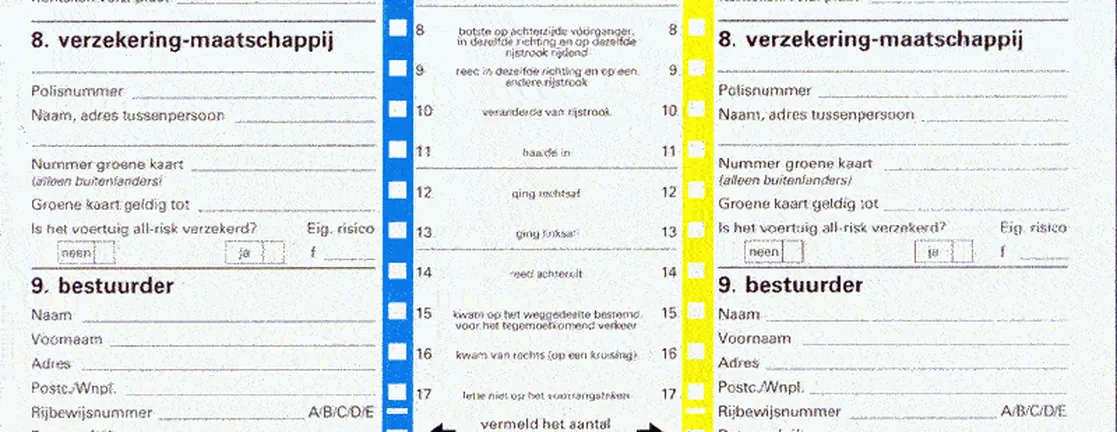
A collision, however small, starts with two things: safety and details. After that you fill in the European accident statement (Europees schadeformulier) together. Below you can see what belongs in every box of that form.
What do you do right after a collision?
Safety first, paperwork after. Stay calm and don't turn it into a row: you don't settle who is to blame together, the insurers do that.
- Make the scene safe Switch on your hazard lights, put on a high-visibility vest if you have one and place a warning triangle. Only bodywork damage and can you still drive? Then move to a safe spot off the road.
- Call 112 if anyone is hurt Is anyone injured, even slightly? Then call 112 straight away.
- When do the police come? With injuries, with severe damage and when someone is driving under the influence, without a licence or without insurance. Also when you can't work it out together, when someone gets aggressive or when the road can't be cleared. The police don't decide who is to blame.
- Record what you see Take photos of the scene and of the damage, and write down the name and phone number of witnesses. You won't track them down later.
The European accident statement
You fill in this form together with the other party. It is called the European accident statement because it is the same in every EU country, Switzerland and a number of countries around the Mediterranean: only the language differs. So abroad you may use the Dutch version too.
Signing is not an admission of guilt. The form only records who was there and what actually happened, so the insurers can settle the damage quickly. You fill in the front together on the spot, the back at home.
Always keep an accident statement and a pen in your car. You get one from your insurer when you take out car insurance; otherwise print this one.
What the form looks like
Click or tap a box for an explanation of what belongs in it. With the buttons under the form you walk through all the boxes.
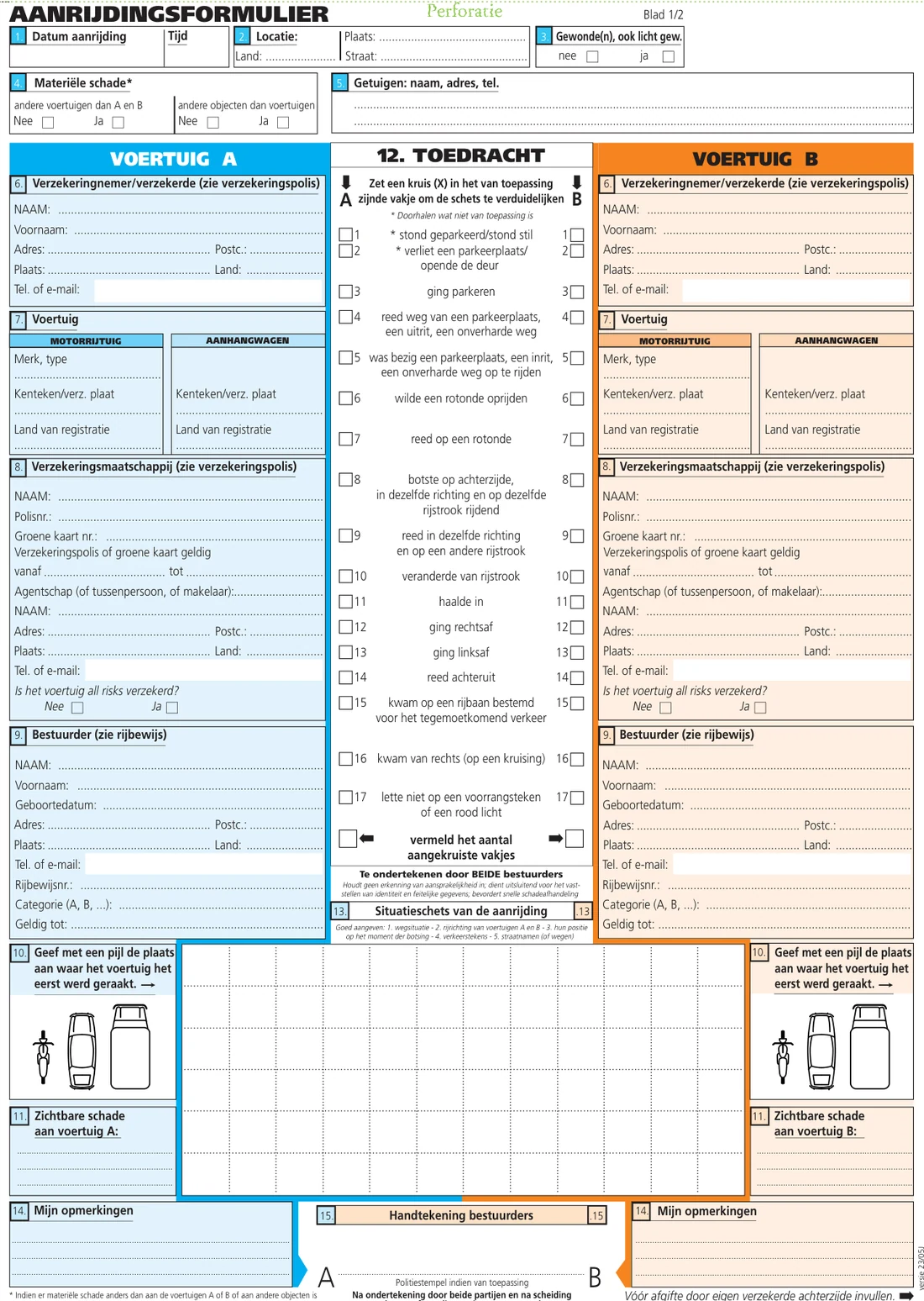
1. Date and time
The date and the time of the collision. Fill that in on the spot, then you know it for sure.
Schematic of the Europees schadeformulier, published by the Verbond van Verzekeraars (the Dutch association of insurers).
Tips for filling it in
- Leave the blame question Don't say straight away that it was your fault. Just after a collision you are shaken and often don't have the situation clear. The insurers decide who is liable.
- Sign last Only sign once the front is complete. After signing and separating the two forms, nothing may be changed.
- A copy each The form comes as two carbon copies. Make sure you both take a signed copy with you.
- Also without another party With single-vehicle damage, against a bollard for example, you fill in the form too. You then leave the Voertuig B side empty.
Sources: Police: the police don't attend every traffic accident, Verbond van Verzekeraars: European accident statement, Rijksoverheid: WA insurance for your vehicle