
You do not have to be a mechanic to keep your car in order. A few minutes a month at the petrol station, and a garage visit on time, saves you a breakdown on the road and expensive repairs. Here you read, part by part, what you do yourself and what the garage does.
Engine oil
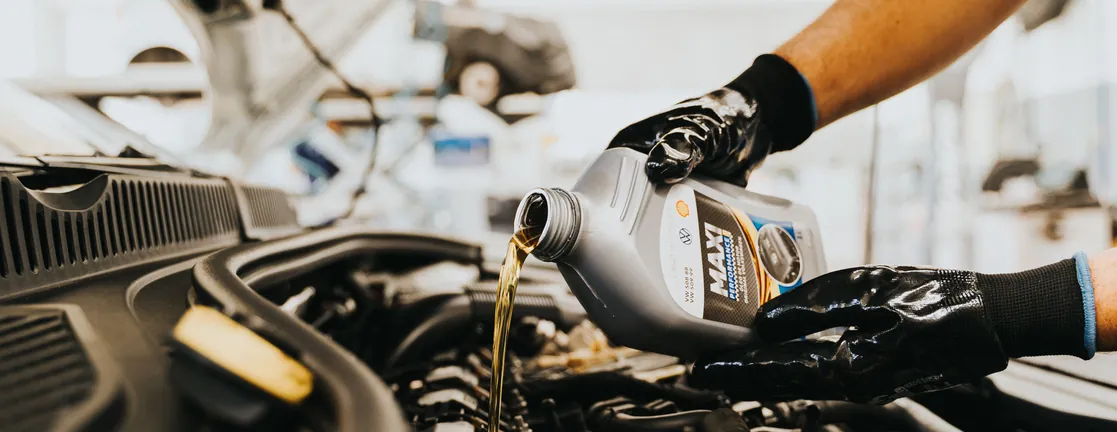
Oil lubricates and cools the engine. Too little oil is one of the most expensive things you can let happen, and one of the easiest things to check yourself.
Check the oil on level ground, with a cold engine that has been standing still for at least fifteen minutes. Pull the dipstick out, wipe it clean, put it back and pull it out again: the level should be between the marks for minimum and maximum.
- Which oil Which oil belongs in your engine is in the car's instructieboekje (owner's manual). Otherwise ask the garage; the wrong oil is not harmless.
- Take a litre with you On a long trip, put a litre of the right oil in the boot. Then you can top up on the way instead of standing still.
- The garage changes it At the kleine beurt (small service) the mechanic changes the oil and replaces the filter. When that is due depends on your car: many modern cars tell you themselves when maintenance is needed.
- Watch the warning light If the oil pressure light comes on while driving, stop as soon as it is safe and call for help. Driving on can wreck the engine.
Tyres
Your tyres are the only contact with the road: four pieces of rubber, each about the size of a sheet of A4. Checking them costs you nothing and they decide how quickly you come to a stop.
- Pressure Check the pressure regularly at the petrol station, on cold tyres. The right values are on a sticker in the fuel flap or the door pillar, and in the instructieboekje (owner's manual). Going on holiday heavily loaded? Then use the values for a full load.
- Tread By law the tread has to be at least 1.6 millimetres deep. The ANWB, the Dutch motoring association, advises replacing them at 3 millimetres, because in a sudden downpour you need those extra millimetres.
- Uneven wear If a tyre wears more on one side than the other, have the alignment checked. Small cracks, bulges or a tyre that keeps going flat: off to the garage.
- Heat and load Warm weather plus a fully loaded car is the main cause of a blowout. So check pressure and tread especially before a long trip.
The kleine beurt and the grote beurt
Servicing is done at the garage. There are two kinds of service, and the difference is in how much is replaced and checked.
The kleine beurt
The mechanic changes the oil, replaces the filter and, according to BOVAG, the Dutch motor trade association, goes through 45 essential points, from the bodywork and the brakes to the shock absorbers and the exhaust. BOVAG gives as an example a service after 20,000 kilometres or 1 year, whichever comes first.
The grote beurt
That is the kleine beurt plus extra work, for instance on the cooling system and the suspension, with more fluids and filters replaced. Exactly what it covers differs per make, model and type.
When is it due?
Many modern cars have a flexible interval and tell you themselves when maintenance is needed. If your car does not, look in the instructieboekje or ask the garage.
An APK, the Dutch periodic vehicle test, is not a service. The test says whether your car is safe enough for the road; it does not change oil or filters. When your car is due for its APK you can read at the RDW.
Keep the invoices and the service book. A car with a documented maintenance history sells more easily and tells the next owner what has been done.
What you can check yourself
Do this round once a month, and certainly before a long trip. It takes you five minutes.
- Coolant The level in the reservoir should be between minimum and maximum. Never open the cap on a warm engine: the system is under pressure and the fluid is boiling hot.
- Screen wash Top up with screen wash, one with antifreeze in winter. Water on its own freezes and leaves streaks.
- Lights Walk round with someone else: headlights, dipped beam, main beam, brake lights, indicators, reversing light and fog light. A broken bulb is a reason to fail the APK.
- Wipers If they smear or make a noise, the rubbers are worn. New blades are cheap and your view is the most important thing you have.
- Brakes If you hear a squeal or a grinding noise when braking, or the pedal feels spongy, go to the garage. Waiting only makes it more expensive.
- Lights on your dashboard Red means stop, amber means have it checked. What each light means you read in Warning lights on your dashboard.
Sources: ANWB: check these points yourself, BOVAG: kleine beurt, RDW: when and how often to have an APK